
You Don't Have a Swing Problem. You Have a Diagnosis Problem
Most golfers spend years fixing symptoms and wonder why the same misses keep showing up. This is where you find out what's actually broken, and build a plan around it instead of guessing your way through another round.
Free. Unsubscribe anytime.
Ever stand over a shot with absolutely no idea where the ball's about to go?
You've watched the YouTube videos.
You've saved drills you think will help.
You've got a couple of training aids.
You might have even had a lesson or video/app swing analysis.
And somehow, on the third hole, it's like none of it ever happened.
That's not a knowledge problem. You know plenty.
Golf doesn't fall apart because you forgot a swing thought.
It falls apart for 2 reasons:
1: There's a disconnect between what you are practicing, and how you are playing.
2: Because one bad hole turns into a spiral.
Either way, once the round finishes you go searching for a fix. Another YouTube video. Another Reddit tip.
But you end up more lost than when you started.
If that sounds familiar, you're not a bad golfer. You've just never had a way to actually diagnose what's going wrong — so you keep patching symptoms instead of finding the root cause.
But what if there was a proven, step-by-step method to fix this - without having to practice more.
Because the shots you remember most are not always the thing that deserves your practice time.
Weekend Golfing is for the golfer who is tired of winging it.
The one who knows there is probably more in there, but doesn't want another vague swing tip or video.
You want a way to work out what is happening, pick a sensible next step, and keep your golf moving in the right direction.
Stop Guessing. Start Diagnosing.
Every email, you'll get one clear, actionable piece of the DIAL Method. The same framework I've used to work my own handicap down, built specifically for golfers who are done throwing random tips at their game and hoping something sticks.
This isn't another list of swing drills. It's a system for figuring out what's actually costing you strokes, improving it with the proper practice, and taking it to the course. So you fix the real thing instead of the symptom in front of you.
Here's what that looks like in your inbox:
D Diagnose Your Game
Find out where you're actually losing strokes, using real data instead of memory or what your playing partners tell you to fix.
Result: You know exactly what to work on first, and why.
I Improve Impact
Fix the specific thing costing you strokes, without a full swing rebuild. Uses differential learning instead of forcing your body into "correct" positions.
Result: Real improvement through a natural learning process, not more swing thoughts.
A Apply Deliberate Practice
Targeted, specific practice that fixes the real cause, not a generic "shorten your backswing" tip that ignores what's actually going on.
Result: Practice that's fun, measurable, and easier to stick with.
L Lower Your Handicap with On-Course Performance
Transfer practice into scores with course strategy, warm-up, mindset, and on-course tools.
Result: It shows up on the scorecard, and you have a system you can keep using for years.
No swing overhauls. No $600 driver you don't need. No 3 tips to try at once and forget by hole 6.
Just practical ideas that help you actually improve, from someone actually doing the work on his own game (not a teaching pro selling you a lesson package).
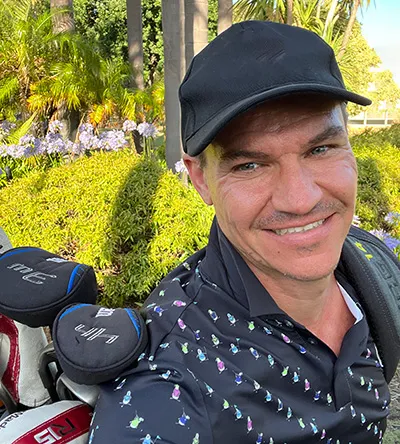
I'm not a golf coach or a pro. I'm a golfer who got tired of guessing.
A few years ago I was stuck.
Playing enough golf to be frustrated by it, but my handicap showed I wasn't really improving much (if at all).
I got tired of throwing time, gear, lessons, and random tips at the problem without a real system for how to actually get better.
What actually changed things wasn't a new swing.
- It was when I got more serious about tracking rounds, looking at the actual pattern and testing exactly what was causing my errors.
- It was when I started trying to improve the thing that matters, impact, instead of trying to "fix my swing".
- It was when I started practicing with a differential learning method I adapted from German sports scientist Prof. Dr. Wolfgang Schöllhorn (along with testing and feedback).
- It was when I started making better decisions (and having more realistic expectations) on the course.
That approach is what eventually became the DIAL Method.
And it's what I did to go from a low-20s handicap to breaking 80 for the first time in less than 12 months and now down to a single-digit handicap.
All while having a full time job, limited practice time, and only able to play a couple of times per month.
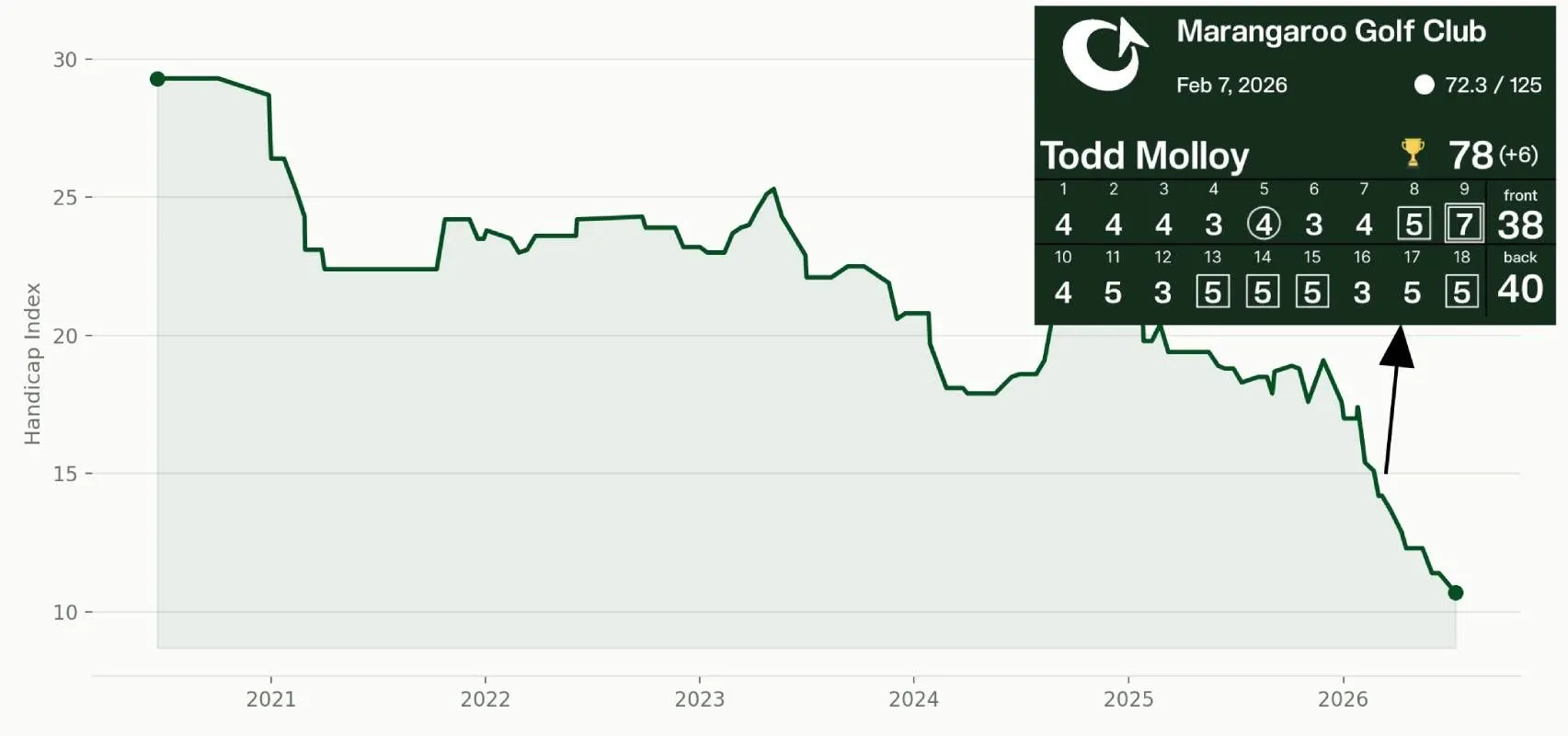
I still hit bad shots. I still have plenty to work on. That's part of why I write this.
I am not here to pretend golf gets easy.
I am here to share the system I wish I had when I was buying more stuff, searching for another answer, and not knowing what I should do to improve.
If you're a weekend golfer trying to get better without turning it into a second job, that's exactly who this is built for. Because that's who built it.
One to two emails a week.
Expect practical notes on things like:
- How to tell the difference between a memorable bad shot and a pattern worth investigating
- How to give a practice session one clear job instead of hitting balls until the bucket is gone
- How to use variation, feedback, and transfer tests so practice is not only good on the range
- How to know when to be aggressive on the course and when you should aim somewhere else
- How to recover from a bad shot (or hole) in a round without spiraling
- What I'm working on, testing, getting wrong, and learning in my own game
- Useful tools, gear, books, courses, and ideas, with an honest explanation of where they helped and where they did not
Some emails will be about the DIAL Method. Some will be a practical golf note you can use that weekend. Some will be a look at a mistake I made so you can avoid making the same one.
All of them should leave you with a better question or one small thing to take into your next round.
Free. Unsubscribe anytime.
This is for you if
- You have tried lessons, YouTube, gear, range work, or golf apps and still feel stuck at your current handicap.
- You play enough golf that you want to improve, but don't have unlimited time to practice.
- You are willing to look honestly at your game instead of blaming a bad round on a few swings or bad luck.
- You're able to do some practice (range or home setup is fine), and you want a way to make your practice actually productive.
- You want a system that connects data, practice, and course strategy.
- You like practical golf advice from someone who is still working through the same game.
It is probably not for you if
- You want a guaranteed score drop by a particular date.
- You want a new mechanical swing fix in every email.
- You are looking for a pro to tell you exactly what is wrong without seeing your golf.
- You are not interested in tracking, reviewing, or testing anything for yourself.
That is fine. There is plenty of golf content built for that.
Start Now
If you are done changing direction after every rough round, put your email below.
I will send practical notes to help you understand your game, practice with more purpose, and play smarter golf.
Free. Unsubscribe anytime.
Questions you might have
Who is this for?
Is it free?
How often will I hear from you?
Is this a swing-fix newsletter?
Are you a golf coach?
One clear next step
You do not need another random golf tip in your inbox.
You need a clearer plan for what to do with the ones you already have.
Free. Unsubscribe anytime.