
For a weekend golfer my 5-wood and 3-hybrid are 2 of my most valuable clubs.
They fill the gap between my driver and my irons, but they do it differently.
Here I’ll show you where and when to use each club.

Understanding 5-Woods and 3-Hybrids
Let me break down the key differences between these clubs based on my experience. While they might look similar at first glance, they’re built differently, and that affects how they perform on the course.
How They’re Built
The 5-wood is the bigger brother here. It’s got a larger head (mine is 120cc) and a longer shaft (~42 inches), which gives you more power behind the ball. The shallow face and wide sole help it glide through the turf smoothly.
The 3-hybrid takes a different approach. It’s more compact (head size of 99cc) with a slightly shorter shaft (40.5 inches), making it easier to control and is replacement for a 3-iron.
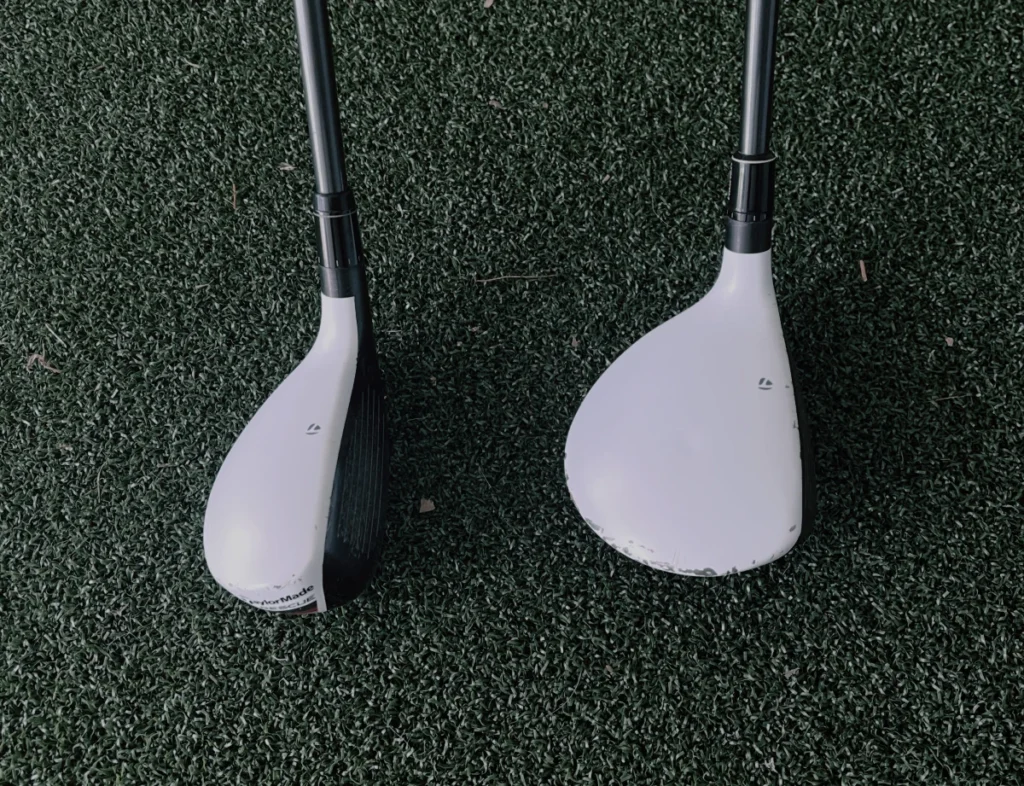
5 Wood vs 3 Hybrid Club Stats
| CLUB | MAKE/MODEL | HEAD VOLUME | LOFT | LENGTH | LIE ANGLE |
|---|---|---|---|---|---|
| 5-Wood | TaylorMade R15 (2015) | 120cc | 19 deg | 42″ | 56.5-60.5 deg |
| 3-Hybrid | TaylorMade R15 (2015) | 99c | 19 deg | 40.5″ | 58-61 deg |

Distance and Flight Patterns
To put some numbers behind it I tested both my 5-wood and 3-hybrid on a launch monitor and here’s how they performed.
* To avoid throwing off the data any terrible shots (fats/thins) I removed
And before you ask – yes these clubs are from 2015. But I did a full bag club fitting in mid-2025 and I wasn’t able to find something that performed better. So despite replacing all of my other clubs, I am still using these same 5-wood and 3-hybrid.
3-Hybrid Performance:
- Club head speed: 90mph
- Ball speed: 122.8mph
- Smash factor: 1.37
- Carry distance: 178.5 yds
- Spin: 4540 rpm
- Launch angle: 15.7 deg
- Descent Angle: 41.7 deg
- Angle of Attack: 2.1 deg
- Peak Height: 27.8 yds
Here’s how the vertical and horizontal dispersion looked, and also where I hit on the club face. Noting the below is shown in meters not yards so you’ll need to add on about 10% for equivalent yards.

5-Wood Performance
- Club head speed: 90.1mph
- Ball speed: 129mph
- Smash factor: 1.43
- Carry distance: 193.8 yds
- Spin: 3540 rpm
- Launch angle: 15.3 deg
- Descent Angle: 39.2 deg
- Angle of Attack: 2.0 deg
- Peak Height: 27.4 yds
Here’s how the vertical and horizontal dispersion looked, and also where I hit on the club face. Noting the below is shown in meters not yards so you’ll need to add on about 10% for equivalent yards.

5-Wood vs 3-Hybrid Performance
And in table format here’s how the 5-wood compares to the 3-hybrid:
| Club | Swing Speed (mph) | Ball Speed (mph) | Launch Angle | Total Spin (rpm) | Descent Angle | Peak Height (yds) | Carry Distance (yds) |
|---|---|---|---|---|---|---|---|
| 5-Wood | 90.1 | 129.0 | 15.3 | 3540 | 39.2 | 27.4 | 193.8 |
| 3-Hybrid | 90.0 | 122.8 | 15.7 | 4540 | 41.7 | 27.8 | 178.5 |
The 5-wood achieved an average carry distance of about 194 yards with a little bit lower spin and a little bit lower descent angle.
The 3-hybrid had slightly higher launch angle and descent angle with higher spin and a shorter carry distance of about 178 yards.
What does this mean?
For maximum distance on a good lie use your 5-wood.
If the lie is not quite as good, or you need more stopping power if hitting into a green then go for your 3-hybrid.
Key Performance Differences
Let me walk you through how these clubs actually perform on the course. I’ve found some clear differences in how they handle various situations.
Distance and Power
The 5-wood is better for distance. With its longer shaft, I’ve found out on the course it’ll typically carry about 10 – 20 yards further than the 3-hybrid and this matches the launch monitor data.
This is because of the bigger head, which will help increase smash factor and get more ball speed from a similar swing speed.
Flight Characteristics
The 5-wood launches shots with less spin, giving you that penetrating ball flight that cuts through the wind. It’s great for shaping shots when you need that extra control.
The 3-hybrid takes a different approach. It gets the ball up a little quickly and brings it down a little steeper — perfect for attacking pins.
The shorter shaft keeps your shots more consistent, and I normally notice tighter shot patterns, especially when not hitting it perfectly (although they were pretty similar in the 10-shot sample size on the launch monitor).
Forgiveness Factor
Here’s where the 3-hybrid really shines. Its compact head design makes it incredibly forgiving on those less-than-perfect strikes, and it’s a lifesaver from tough lies in the rough.
The 5-wood still holds its own, particularly from a clean fairway where its wider sole can really glide through the turf.
However, if you’re looking for consistency across different conditions, the 3-hybrid typically delivers more predictable results.
Playing Conditions and Course Situations
Clubs handle different course conditions in their own unique ways. Here’s what I’ve learned from playing them in various situations.
From the Fairway
The 5-wood is a fairway specialist. Give it a clean lie on short grass, and it’ll reward you with impressive distance. The longer shaft and bigger head work together to maximize your ball speed when conditions are perfect.
The 3-hybrid might give up a few yards, but it’s more adaptable. It doesn’t need a perfect lie to perform well, and that shorter shaft helps you maintain control when the fairway isn’t pristine.
Rough and Recovery Shots
Playing in the rough to recover from a bad tee shot is where the 3-hybrid really earns its spot in the bag. Its compact head design cuts through thick grass. I’ve found it particularly effective for:
- Getting out from under trees with a punch shot
- Managing uneven lies
- Dealing with patchy rough
- Salvaging shots from divots
The 5-wood? It tends to struggle here. That larger head often gets caught up in the thick stuff before you can make solid contact.
Skill Level Considerations
Your skill level plays a big role in choosing between these clubs. I’ve noticed some clear patterns in what works best for different players.
For Beginners
If you’re just starting out, grab that 3-hybrid. The shorter shaft gives you way more control than the longer 5-wood, and that’s exactly what you need when you’re learning the game. Its compact head helps you make better contact more often, and you can normally get the ball up in the air without much effort.
You can use it from pretty much anywhere — fairway, rough, even for little chip shots around the green. Plus, it’s really forgiving when you don’t hit it perfectly.
For Advanced Players
Once you’ve got your swing dialed in, the 5-wood starts to shine. That extra shaft length and bigger head lets you work the ball more effectively and squeeze out extra yardage compared to the hybrid.
Advanced players can really take advantage of what the 5-wood offers. You can shape shots better, control your trajectory more precisely, and really maximize distance when you’ve got a clean lie. The lower launch and spin can give you those penetrating shots that cut through the wind.
The key difference? The 5-wood rewards good technique, while the 3-hybrid helps you manage the course even when your swing isn’t perfect. That’s why you’ll often see better players mixing both clubs in their bag, using each one for specific situations.
Making the Right Choice
I’ve realized that choosing between a 5-wood and 3-hybrid comes down to your natural swing style and what feels comfortable in your hands.
Know Your Swing
Your natural swing tendencies tell you a lot about which club might work better. If you’ve got a slower swing speed, the 5-wood’s longer shaft can help you squeeze out extra yards.
However, if you tend to hit down on the ball (like most of us do with irons), you’ll probably love how the 3-hybrid’s compact head handles that steeper attack angle.
Players who sweep the ball with a shallower swing often click better with the 5-wood’s wider sole. And if you like to work the ball left and right, the 5-wood typically gives you more options to shape your shots.
Getting Fitted Right
Don’t just take my word for it — get these clubs in your hands and test them out. A proper fitting session will tell you everything you need to know about:
- Your swing speed
- Your natural launch angle
- Your typical spin rates
- Real-world carry distances
My best advice? Schedule a fitting when you’re fresh — ideally during your usual playing time. Try different shaft options that match your tempo and how you load the club. The shaft is much more important than the head.
After many years playing, I’ve noticed that neither the 5-wood nor the 3-hybrid is automatically the “right” choice. It’s all about what works for your game.
Grab both clubs and spend some time with them on the range. If you’re fighting for consistency in your long game, the 3-hybrid’s forgiveness might be exactly what you need.
However, if you’re comfortable with your swing and usually play from decent lies, that five wood could add those extra yards you’re looking for.